

Software was supposed to remove friction. Instead, for businesses of all sizes, it has become one of the largest sources of it.
It is quite possible you have experienced this on your own cell phone. When you look at your phone screens do you see too many apps? And in your daily life, how many subscriptions and charges do you have to hunt down and cancel, for things you rarely use?
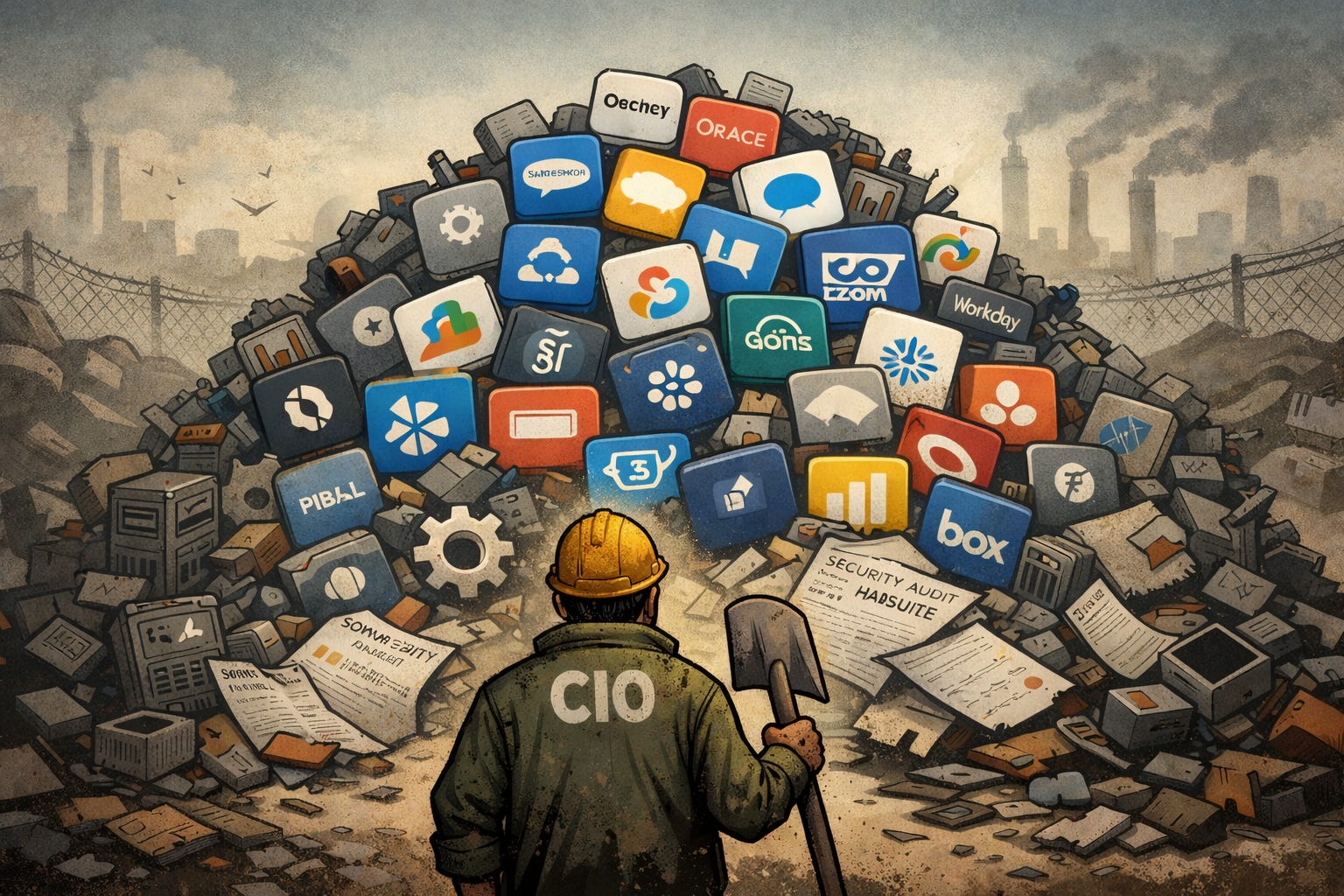
Something quite similar faces organizations large and small today as they survey the long list of software they have accumulated. Software whose ever present sales teams had earnestly promised would liberate people from drudgery and make organizations lean and efficient. To many CIOs it looks like a costly mess: a pollution dump and a security disaster waiting to happen.
But fixing it is a political and organizational minefield, with very little support from above, or for that matter from business units. Over the past decade, enterprises have accumulated sprawling SaaS estates. Depending on how portfolios are measured, mid-sized and large companies routinely operate with anywhere from 100 to more than 250 SaaS applications in active use.
Annual SaaS spend now commonly reaches tens of millions of dollars in large enterprises, with per-employee software costs measured in the thousands of dollars per year. The precise figures vary by methodology, but the operational outcome is consistent: a growing share of work exists solely to keep tools aligned with one another.
The precise figures vary by methodology, but the operational outcome is consistent: a growing share of work exists solely to keep tools aligned with one another.
The real product is data entry
As CTO of one of the largest banks in America, I saw this every day. The defining feature of a lot of the work people had to do was re-keying, reformatting, and re-explaining information so it can exist inside different systems. When this became overtly burdensome, we would make efforts to integrate and connect systems with APIs and ETL feeds, but those integrations in turn produced rigidity, and an inability to react to changing market dynamics quickly.
A deal update might live in the CRM, but the same update would get rewritten for a forecasting tool, referenced in a project tracker, and reconciled again in finance. Employees do integration work because even the best API integrations and data feed approaches fundamentally fail.
Studies of digital work patterns have shows knowledge workers often need to switch between applications hundreds of times per day, with the cumulative cost amounting to several hours per week lost to context switching alone. Even if the exact number differs by role or organization, the underlying reality is quite common. Context is fragmented across tools, and people spend time reconstructing it or slightly updating it to match subtle differences in “semantics” between different systems.
Why CIOs end up owning everyone else’s mess
Each new SaaS product introduces its own data model, permissions system, workflow logic, and training burden. That burden does not stay local to the buying team. It lands on IT, security, and the rest of the organization, which must now operate in a more fragmented environment.
When you talk to real users in organizations what you will quickly learn is that a small group of power users learn a tool deeply, but the vast majority of employees learn only what is required to avoid blocking someone else. Management often purchased the tool for specific anticipated benefits, but the features that justified the purchase remain largely unused. In my enterprise roles, when contracts where set to renew, procurement teams would reach out to me as a CTO, asking if a particular tool was still needed, how many seats we were using, etc. Even finding this information was very challenging, let alone truly understanding the value employees were getting from a different pieces of SaaS software.
The net result was vendors have enterprises over a barrel, and renewals and seats grow and grow, and management almost never closes the gap to understand if the tool is really valuable or not.
Redundancy of tools is also quite literally everywhere. Many enterprises run double-digit counts of tools in categories like analytics, data stores, project management, collaboration, and training. Different departments and business units routinely purchase tools that do more or less the same thing as tools that the company is already paying for. This is not the result of architectural choices, or nuanced analysis of needs. It is the accumulated outcome of decentralized purchasing and weak incentives to remove software once it is in place.
Security and IT inherit the consequences. Each additional piece of SaaS software expands the attack surface and creates more places where sensitive data can be leaked. Employee-expensed applications are particularly risky, with a large share assessed as having weak security postures.
Data silos are the SaaS business model
Even when SaaS tools expose APIs, integration is rigid and expensive. Vendors encode different assumptions about entities and workflows. Departments define the same concepts differently. Business processes evolve faster than integrations can be rewritten.
The practical result is that no system is fully authoritative. Dashboards disagree. Reports require manual reconciliation. Decision-makers lose trust in metrics because no one can explain discrepancies without digging through multiple tools.
Moreover, as enterprises lash together SaaS systems with data feeds and integrations to try to reduce manual data entry, the ETL feeds and connections become rigid parts of the IT landscape, dangerous and costly to tamper with, impeding change and agility.
This is where SaaS crosses into pollution. It consumes attention, fragments context, and externalizes coordination costs onto employees.
Waste becomes structural, hard to detect, and ossified
SaaS waste is often framed as overspending, but the deeper issue is underutilization, hidden labor, and rigid system integrations that are very costly to change.
Across multiple industry studies, enterprises consistently report using roughly half of the licenses they pay for. Annual wasted SaaS spend is measured in the tens of billions of dollars globally, with individual large companies often wasting tens of millions per year on unused or lightly used software.
At the same time, per-employee SaaS spend remains high enough to matter at the board level. Estimates cluster around $4,000 to $6,000 per employee per year. Even modest inefficiency at that scale translates into real money, and into real time spent maintaining systems instead of doing core work.
“Copilots” in legacy tools don’t address the real problem
Of course SaaS vendors are vigorously packing their products with AI features, particularly copilots and other agentic tools. These additions do help with common tasks and can make using many tools less burdensome, but they do not change how work is structured. Coordination between tools still falls to humans.
A copilot inside a CRM cannot resolve inconsistencies between the CRM and finance. A copilot inside a ticketing system cannot align priorities across product, support, and sales. Each one operates within a silo and reinforces the fragmentation that already exists.
In many cases, copilots increase variance rather than reduce it. Different tools generate different summaries of the same situation. Humans still perform the reconciliation.
The urgent alternative? “True Agentification”
Enterprises need to AGENTIFY quickly. That means shifting from tool-centric software to goal-centric processes, where humans and AI agents help each other to achieve results. Enterprise data, well structured and meaningful, should be a natural byproduct of productive work, not a burden on employees and managers.
An effective AI agent operates across systems, maintains context over time, and performs real operational work. It updates records in multiple systems, reconciles inconsistencies, advances tasks, and escalates decisions when human judgment is required. In the short term, agents can reduce pain by operating on top of existing SaaS stacks and stripping out mechanical labor.
The larger payoff comes when enterprises start removing software, and replacing it totally with capable AI agents that can work alongside humans and empower them in a way that SaaS has now 100% proven it cannot.
This is also a huge opportunity for agent builders to disrupt traditional SaaS companies. If your interests are in building please see our earlier post “Why Agentify” and also please consider reading the just published book:
Agentify: The Art, Science, and Engineering of Successful AI Agents
Organizations have to delete things, but it is hard, really hard
AI-native efficiency does not come from layering automation on top of a bloated array of tools each with siloed data. It comes from reducing the number of tools. This in turn can begin to allow AI agents to operate on coherent data. To do this requires building consensus across groups, and confronting teams for which a particular piece of software is a sacred cow, or actually may be protecting their jobs.
CIO’s need support from the board, business unit leaders, and CEOs to do several things at once:
Retire redundant tools, even when each has internal advocates.
Standardize core objects and definitions across departments.
Centralize governance over procurement, identity, data access, and offboarding.
AI agents can help accelerate this process because they expose inconsistencies that humans have been quietly compensating for. When an agent cannot determine which system owns a field, that is a governance failure that has already been paid for in human time.
The next two to three years are crucial
Organizations that move now will deploy agents to remove drudgery while aggressively shrinking their SaaS estates. Those that do not will continue paying the hidden tax of tool sprawl while AI-native competitors design operating models that never require this level of manual work.
Enterprise data, well structured and meaningful, should be a natural byproduct of productive work, not a burden on employees and managers.
Enterprises that cling to sprawling SaaS estates will miss the larger prize of AI. Their people will stay busy reconciling systems instead of solving problems, and copilots inside those tools will only decorate the workload. These enterprises may tout “high AI adoption,” and you will hear endlessly about AI in their earnings calls, but they will remained trapped by their legacy SaaS.
Agentification offers a different path: AI agents that work across systems, carry context, and execute tasks without being trapped by software or departmental boundaries. Companies that make this shift will become AI-native and capture the real productivity gains. Those that do not will watch newer competitors, built without SaaS baggage, take that advantage and turn it into market share.
References
AGENTIFY - The Art, Science, and Engineering of Successful AI Agents
https://taosresearch.ai/learning/agentify-the-art-science-and-engineering-of-successful-ai-agentsOkta – Businesses at Work (annual report series)
https://www.okta.com/resources/businesses-at-work/BetterCloud – State of SaaS 2024
https://www.bettercloud.com/resources/state-of-saas/Zylo – SaaS Management Index 2024
https://zylo.com/resources/saas-management-index-2024/Zylo – SaaS Management Index 2025
https://zylo.com/resources/saas-management-index-2025/Productiv – SaaS spend benchmarks and reports
https://www.productiv.com/resources/University of California, Irvine – Gloria Mark et al., research on context switching and digital work
https://www.ics.uci.edu/~gmark/Microsoft Research – Studies on multitasking, interruptions, and productivity
https://www.microsoft.com/en-us/research/group/human-computer-interaction

Very true! Most large Enterprises surrendered long ago to the cloud/SaaS hybrid OpX services model … which now creates a very difficult “Agentification” challenge which may likely force the enterprise to pick a cloud and sass vendor coalition, and their AI agent models. Hence the big spend for the infrastructure from the cloud vendors.
I’m wondering if this situation brings back a retrospective look at private cloud and private proprietary Agent development